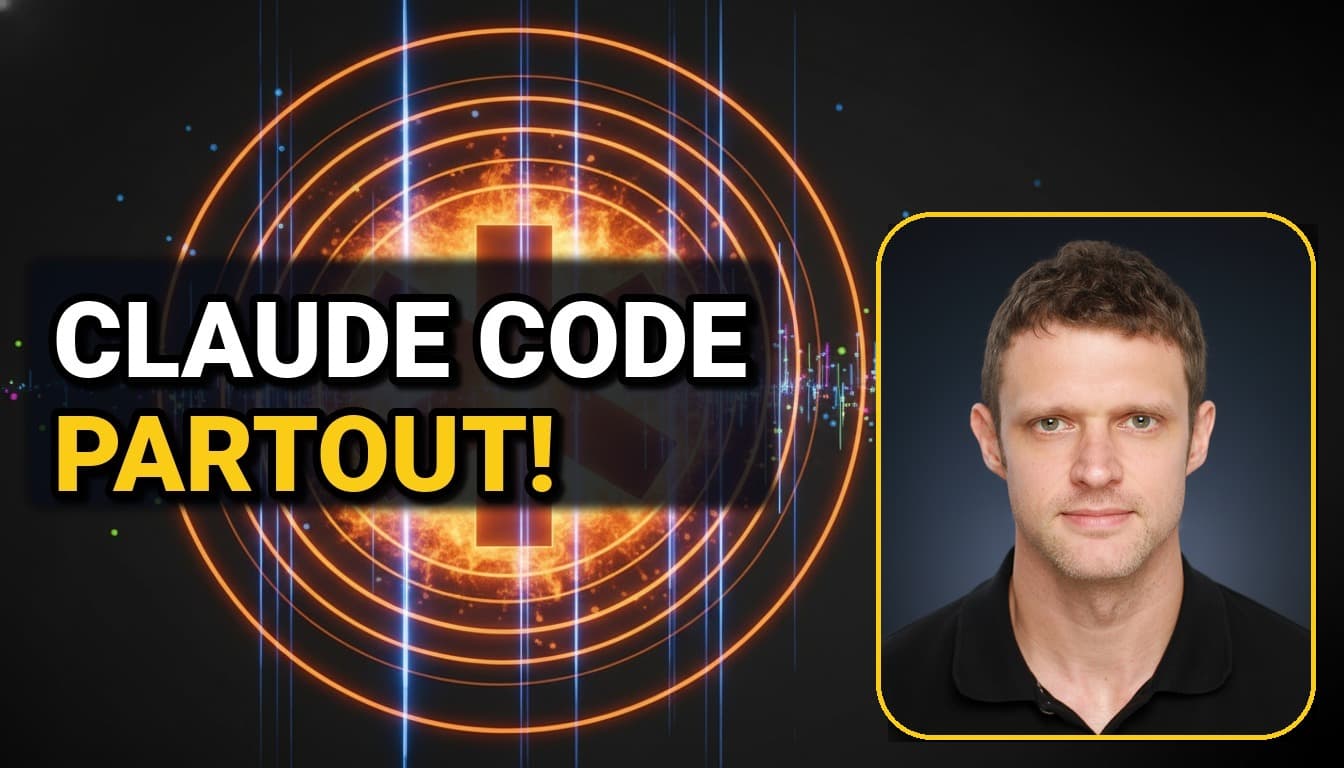
The signal came from an unexpected place. Mercury, the neobank serving a third of American startups, just published an analysis of its new clients' technology choices: Anthropic has overtaken OpenAI as the top model picked by startups in 2026. Claude Code in every startup is an observable reality in the data, not a keynote promise.
And just this week, Anthropic launched Claude Design, a tool that generates interactive prototypes, landing pages, and pitch decks from a simple prompt. This launch says something specific about the direction Anthropic is heading, and what it concretely means for anyone building a product this year.
- 🔑 New startups are choosing Anthropic over OpenAI according to Mercury's 2026 data.
- ⚠️ Claude Design takes direct aim at Figma, Canva, and Adobe with a research preview launch.
- 💡 A VP Product at Mercury built a complete "second brain" with Claude Code in real-world conditions.
- 🚀 The Claude Design to Claude Code loop lets you go from concept to production code without switching tools.
Claude Design: Anthropic's declaration of war
Claude Design just launched in research preview for Pro, Max, Team, and Enterprise subscribers. The concept is simple: you describe what you want, Claude builds a first version, you refine through natural conversation. No Figma, no Canva, no designer on standby.
This is not a gimmick.
In five minutes of live testing, the creator of the Build In Public channel rebuilt the complete landing page of his EasyFlip app from a single URL. Dark mode, motion, product sections, pricing, testimonials. The result is not perfect on every detail, but it is directly usable as a foundation.
What sets Claude Design apart from other vibe-coding tools is its initial configuration step. The tool reads your codebase and design files, builds a design system from what it finds, and automatically applies your colors, fonts, and spacing to every new creation. You do not have to re-teach the tool who you are at every session.
The other standout feature: "Tweaks." These are not generic sliders. Claude generates adjustment controls tailored to your specific project, decides on its own which variables deserve to be exposed, and builds the options accordingly. No other tool does this today.
The cherry on top: a "Hand off to Claude Code" button transforms the prototype into production-ready code. The loop is closed. Concept, prototype, code, without switching tools.
The direct competitor named by every observer is Figma. Figma's stock dropped 10% on launch day. And for good reason: Anthropic is not bolting an AI engine onto existing software. They built Claude Design from the AI outward to the interface, not the other way around. That changes everything about what the tool actually understands about a project.
What Mercury's data does not say out loud
Ryan Wiggins, VP Product at Mercury, shared something rare during an interview: real data on startup technology choices. Mercury serves a third of American startups. This is not an anecdotal sample.
For three or four years, OpenAI dominated without question. By early 2026, for every new cohort of startups, Anthropic had become the top model choice.
A single initial choice locks in many subsequent decisions.
Wiggins explains it clearly: once a startup has built its workflows around Claude Code, with its context files (CLAUDE.md, project memory, configured hooks), moving to Codex or OpenAI becomes painful. It is no longer a simple API key swap. It is an entire production system to rebuild elsewhere.
The first model choice then drives the enterprise license, internal chat, and integrations. This is not loyalty, it is switching cost. And Anthropic is winning that first choice at scale.
Revenue figures confirm the momentum: $9 billion in annualized revenue at the end of 2025, $30 billion by April 2026. That progression in just a few months is not the trajectory of a player surviving in a competitive market. It is the trajectory of a player pulling ahead.
The "second brain": Claude Code in real-world conditions at Mercury
Wiggins also shared something even more concrete: his daily use of Claude Code as a personal decision-making infrastructure.
He gathered five years of Mercury context into a local knowledge base: nearly 5 million words of specs, queries, strategy docs, and meeting transcripts via Notion. This base feeds every prompt through Claude Hooks. The result: when he asks "How is activation trending?", Claude responds with the full product context injected into the query, not in a vacuum.
This is no longer occasional assistance. This is orchestration.
He then built an automated data analyst capable of answering 80 to 90% of business questions from cross-functional teams at Mercury. A local prototype, refined until reliable, then deployed internally across the entire company.
This use case illustrates exactly what I have been arguing for a while: the real advantage does not come from using AI occasionally. It comes from building an industrialized software production system around these tools. Wiggins did it for himself, then scaled it for his team. That is the right direction.
The tool also serves as a performance coach. Every evening, he asks Claude to analyze his day's meetings (transcribed via Notion), compare his behaviors against the improvement areas from his last performance review, and flag any gaps. The result: his manager and HR receive fewer surprises during semi-annual reviews.
Anthropic tools comparison: who does what today
| Tool | Primary profile | Key use case | Access requirement |
|---|---|---|---|
| Claude Design | Founders, PMs, non-tech | Prototypes, landing pages, slides | Pro / Max / Team / Enterprise |
| Claude Code | Developers, tech leads | Code, agents, workflows | CLI (npm/pip) |
| Claude Co-Work | Mixed product teams | Multi-agent collaboration | Claude.ai |
| MCP Claude | Developers, builders | Third-party API integrations | Open source |
| Claude.ai Projects | All profiles | Shared knowledge base | Pro and above |
This table illustrates something important: Anthropic is no longer just building a model. They are building a coherent product suite where each tool serves a different profile yet stays interconnected. Claude Design transfers to Claude Code in one click. Claude Code can call third-party MCPs. Claude.ai projects feed context into every agent. The suite is growing deliberately.
What this changes for tech teams and founders
I will be direct. Claude Design will not kill designers. But it will make it very hard to justify a junior designer for a startup's first mockups in the early stage.
The point raised by Saptarshi Prakash (senior designer at Swiggy) in his analysis is fair: Claude Design handles visual production, direction exploration, and style consistency very well. It is considerably weaker on deep product decisions, complex information hierarchy, and UX nuances. When he asked the tool to simplify an interface by deciding on its own what is essential versus nice-to-have, the tool announced decisions it never actually applied. Those are precisely the trade-offs a good designer knows how to make.
The threat weighs on "correct and cheap," not on excellent.
For teams like ours at GoLive, the equation shifts differently. We already see clients arriving with Claude Design prototypes and asking to move straight to implementation. The brief-mockup-validation cycle is shrinking. That accelerates projects. It is not threatening, it is a gain.
What this confirms at a deeper level: developers who use Claude Code need to know how to read a prototype, identify what is missing on the architecture side, then implement it properly. The tool covers the first kilometer; the engineering team covers the next nine. The boundary between AI agent and human developer is shifting, not disappearing.
For non-technical founders, the change is more radical. You can walk into an investor meeting with an interactive prototype you built yourself in one hour. You can test product hypotheses without waiting for a sprint cycle. AI agents make these workflows accessible to profiles that could not have considered them twelve months ago.
What I have been telling my clients for six months: AI does not replace the team, it changes the order of steps. You validate earlier, you invest in engineering later, and you invest better. Claude Design accelerates that logic by another notch.
My verdict: this is not a hype cycle
There is something structurally different about what is happening with Claude Code and the Anthropic ecosystem. This is not a tool you try once and then abandon. It is a tool that integrates into daily workflows, accumulates context, and creates productive dependency.
The real product is not the model. It is the system you build around it.
Mercury's data is indirect proof. Startups are not choosing Anthropic because the model is marginally better on a benchmark. They are choosing Anthropic because Claude Code, MCPs, project memory, and now Claude Design form an ecosystem in which they can actually operate.
Wiggins himself says it: he tried to duplicate his second brain on Codex. He could not do it easily. All the accumulated context, the hooks, the memory, the file structure, that is an advantage that does not transfer overnight.
That is exactly the real competitive advantage with these tools: not the isolated feature, but the ecosystem built around it. Startups that understood this before others are already several lengths ahead. And for developers and teams working with AI, the question is no longer whether these tools will change practices. It is how fast you are building your own system.
- Claude Design by Anthropic · Build Full Websites with AI (Step-by-Step Demo) · AI BROS
- Claude Design Is INSANE, Designers Are COOKED [The Truth] · Saptarshi Prakash
- How to Create AI Agents and a Claude Code Second Brain in 25 Minutes | Ryan Wiggins · Peter Yang
- Claude Design - Everything You Need to Know · Build In Public